
Japanese communication among foreign employees – What's happening on the ground?

The reality of the "language barrier" faced by both foreign employees and companies.
Many companies that hire foreign employees first face the challenge of communication due to the language barrier. While foreign employees may be able to hold everyday conversations, they struggle to understand specialized terminology, industry-specific expressions, or the ambiguous expressions unique to Japanese people. On the other hand, the company (Japanese staff) also worry about whether work instructions are being accurately conveyed, which often leads to a breakdown in communication and reporting. This discrepancy in understanding between both sides is not merely a matter of miscommunication, but a serious problem that can lead to decreased work efficiency and deterioration of workplace relationships.
Specific examples of communication challenges by industry
The challenges caused by language barriers manifest in specific ways depending on the industry. For example, in manufacturing, the inability to accurately convey machine operation procedures or safety check instructions poses a risk of serious workplace accidents. In elderly care settings, advanced communication skills are required to accurately understand vague complaints from users, such as "I feel a little pain" or "I'm not feeling well," and report them to Japanese staff. Furthermore, in the food service and retail industries, insufficient understanding of detailed hygiene management rules, as well as proper customer service, can lead to problems directly impacting store operations.
The risk of "employee turnover" caused by language barriers
Neglecting communication challenges directly leads to the biggest risk: the early departure of foreign employees. When language barriers cause repeated work errors and strained relationships with Japanese staff, foreign employees feel increasingly isolated in the workplace. This psychological stress of "not fitting in" is one of the biggest factors that leads them to decide to quit. Hiring foreign talent can easily cost hundreds of thousands to over a million yen per person. Losing such valuable employees after investing in their recruitment is not only a significant financial loss for the company, but also leads to a decline in morale among employees.
The "invisibility" of Japanese language proficiency—common misconceptions when assessing ability

"Speaking ability" that cannot be assessed solely through the JLPT (Japanese Language Proficiency Test)
Many companies use the passing level of the JLPT (Japanese Language Proficiency Test) as a benchmark when assessing the Japanese language level of foreign employees. However, the JLPT is a multiple-choice test that primarily measures reading and listening skills, and does not directly evaluate speaking or writing abilities. As a result, companies often hire employees expecting them to be able to communicate without problems in the workplace because they have passed N1 (the highest level) or N2, but in reality, they frequently struggle with oral work reports and responding to spontaneous questions. It is important to understand that there is a significant gap between test scores and the actual speaking ability required in the workplace.
Why "Being able to have everyday conversations does not equal being able to do the job"
Even if you feel you can hold a fluent everyday conversation during an interview, that doesn't necessarily translate directly to your ability to perform the job. In everyday conversation, meaning can often be inferred from context and gestures, and communication can still be achieved even with some grammatical errors. However, business communication requires the accurate transmission of facts, logical explanation of situations, and timely reporting and consultation. These are completely different skills from everyday conversation. What companies should expect from foreign employees is not advanced and perfect business Japanese, but rather a solid foundation of "basic communication skills" that enable them to accurately exchange information necessary for their work.
How to accurately assess the Japanese language level of your foreign employees
To provide appropriate training to foreign employees, it is essential to first accurately understand their current Japanese language level. To achieve this, it is effective to conduct level checks that simulate actual work scenarios, rather than relying solely on qualification exam levels. For example, using international language proficiency standards (such as CEFR) ranging from "A1 (beginner) to B1 (early intermediate)," one can evaluate them using practical indicators such as "can introduce themselves," "can understand simple work instructions," and "can explain the situation in a problem." Only by accurately knowing their current level can an effective training plan be developed.
Main Methods of Japanese Language Training: A Thorough Comparison of Advantages and Disadvantages

In-person training (group sessions, instructor dispatch)
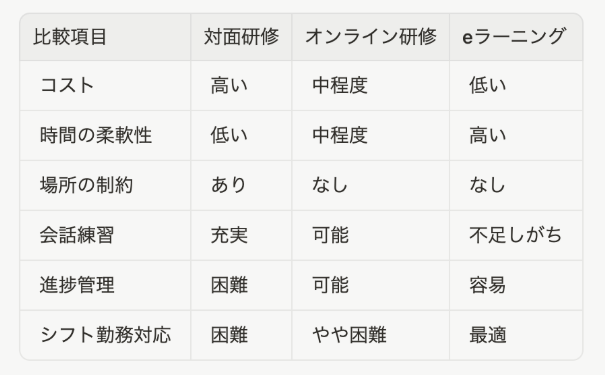
In-person training is a traditional method that involves sending Japanese language teachers to companies or having employees attend Japanese language schools. The biggest advantage is the sense of presence gained from direct interaction with the instructor and the interactive nature of being able to resolve questions on the spot. It is also ideal for detailed pronunciation correction and practical practice through role-playing. On the other hand, the initial costs, such as instructor dispatch fees and venue fees, tend to be high. Furthermore, since it is necessary to gather everyone at a fixed date and time, scheduling becomes extremely difficult in workplaces where shift work or night shifts are common, which is a major disadvantage.
Online training (live streaming)
Online training is a method of receiving instruction from an instructor in real time using web conferencing systems such as Zoom. A major advantage is that it maintains the interactivity of in-person training while being free from geographical constraints. Even companies with multiple locations can gather employees into a single online classroom and conduct training simultaneously. However, just like in-person training, it requires employees to "attend at a fixed time," so the challenge of accommodating shift work remains. In addition, a stable internet connection is necessary, and it can be difficult for instructors to gauge each participant's level of understanding and concentration through a screen, which can make maintaining motivation a challenge.
e-learning (video-based learning)
E-learning is a method of learning where learners use pre-recorded video materials and apps to study at their own pace. The biggest advantage is that there are no time or location constraints whatsoever. As long as you have a smartphone, you can use spare time such as commuting time or break time to study, making it ideal for employees on shift work. In addition, the implementation costs are significantly lower compared to face-to-face training. On the other hand, since it is based on self-study, it has the disadvantages of making it difficult to manage learner motivation and often lacking opportunities for "speaking" (output).
[Comparison Table] Compare three training methods at a glance
The characteristics of each training method can be compared as follows:
Four checkpoints for choosing the best Japanese language training program for your company

Check 1 – Is the training style suitable for the work environment?
The first point to consider when choosing training is whether it can be easily integrated into your company's work schedule. In workplaces where shift work or night shifts are common, such as manufacturing plants, nursing homes, and restaurants, face-to-face training that requires everyone to gather at the same time is not practical. In such environments, e-learning-type training, which allows employees to learn at their own convenience using smartphones or tablets, is the most suitable. Check whether there is a system in place that lowers the barrier to learning and allows employees to easily incorporate learning time into their daily lives.
Check 2 – Does it have both "input" and "output"?
In language learning, simply memorizing vocabulary and grammar ("input") is not enough to develop the ability to actually "speak" in real-world situations. E-learning is ideal for input, but it's insufficient on its own. It's crucial to choose training programs that include opportunities for "output," where you can use the knowledge you've learned in real conversations. For example, a "hybrid" training program, where you primarily study independently using e-learning and regularly practice conversations with an instructor through online meetings, strikes a balance between input and output, allowing you to efficiently cultivate practical communication skills.
Check 3 – Is there support available in the native language?
For employees at a beginner level (around A1-A2) who have just started learning Japanese, having Japanese grammar explained solely in Japanese is a significant hurdle and can lead to frustration. Therefore, whether training materials and systems offer explanations and support in the learner's native language (English, Chinese, Vietnamese, Nepali, etc.) is key to ensuring continued learning. Support in their native language allows learners to accurately understand grammatical nuances and meanings, dramatically improving learning speed and retention. Checking for multilingual support is an essential point to consider.
Check 4 – Can learning progress be "visualized"?
When implementing training programs as a company, measuring and managing their effectiveness is essential. Ensure that the company has a system (LMS: Learning Management System) that allows administrators to track in real time "who is learning how much" and "how well they understand the tests." Visualizing learning progress allows for support for employees who are falling behind. Furthermore, if learning outcomes are compiled in the form of monthly reports, the return on investment (ROI) of the training can be clearly reported to management, making it easier to gain their understanding for continued investment in education.
Enhance practical skills through hybrid learning combining input and output - Plat Clover
Operated by Clover Academy, which boasts a history of over 33 years and a track record of educating over 10,000 students.
Platt Clover was developed based on the teaching know-how cultivated in the Japanese language education field at Clover Academy, which opened in 1990.

The learning content starts with the basics, such as hiragana and katakana, and gradually progresses to beginner-level everyday conversation, making it easy for even complete beginners to learn Japanese.

Furthermore, "Japanese for Daily Life" helps students acquire the expressions and knowledge necessary for everyday life, such as shopping and using public transportation.
Furthermore, the curriculum includes information on Japanese culture and customs, incorporating content that supports all aspects of life in Japan. This design, based on actual educational settings, is one of the reasons why students can learn with confidence.

Platt Clover's curriculum includes content and animated learning materials that can be accessed through the app, making it visually easy to understand and suitable for repeated learning.

Furthermore, the incorporation of game-like elements lowers the barrier to learning and creates an environment that makes it easier to continue.

Furthermore, a key feature is that online interviews are conducted at certain learning stages to check understanding and provide individual support. In addition, informational content such as "How to Travel in Japan" helps deepen understanding of life and culture in Japan.
This complex design creates a system that allows students to continue learning without difficulty.
Hybrid learning combining e-learning (input) and online interviews (output)
At Platt Clover, we have a system in place that allows students to acquire basic Japanese language knowledge through self-study via e-learning.

The curriculum starts with the basics, such as hiragana and katakana, and progresses gradually to beginner-level everyday conversation. A key feature is that users can repeatedly study within the app. In addition, the content utilizes animations and other visual elements to make it easy to understand.

Furthermore, online interviews are conducted at certain learning stages to check students' understanding of the material and provide opportunities to actually use Japanese. A key feature is that students don't just keep the knowledge they've gained through self-study, but instead output it through conversation, ensuring that they steadily solidify their understanding from the basics.

Platt Clover is compatible with multiple devices such as PCs and smartphones, providing an environment where you can learn anytime, anywhere.

With content available through the app, you can easily continue learning even during spare time such as your commute or breaks.
Furthermore, because each learning element is broken down into small, manageable sections, the structure makes it easy to continue studying even in short bursts of time.

Furthermore, informational content on "Japanese for Daily Life" and Japanese culture and customs is available online, allowing learners to progress with their studies and understanding of daily life simultaneously. This high degree of flexibility in the learning environment is one of the factors that makes it easier to continue learning.
Specializing in A1-B1 levels – build a strong foundation and acquire "practical Japanese for real-world situations."
Platt Clover's aim is not to teach advanced business Japanese, but rather to focus on understanding and using Japanese that can be used in everyday life and familiar situations.

The curriculum focuses on learning basic conversational expressions and everyday interactions.
"Japanese for Everyday Life" helps you acquire expressions that are relevant to specific everyday situations such as shopping and getting around.

Furthermore, by repeatedly studying content within the app and providing opportunities to actually use Japanese in online interviews, the program aims not only to acquire knowledge but also to solidify practical application skills. Its distinctive feature is that it emphasizes the fundamentals while connecting them to practical communication skills that can actually be used.
Supports 4 languages, costs approximately 1/3 the price of in-person training, and visualizes progress with monthly PDF reports.
Platt Clover offers support in four languages—English, Chinese, Vietnamese, and Nepali—to ensure that even foreign learners unfamiliar with Japanese can participate with confidence.

A key feature of this approach is that it allows students to receive support in their native language or a language they find easy to understand during the initial stages of learning, which facilitates comprehension and reduces initial difficulties.
In particular, for beginners who tend to feel anxious about learning only in Japanese, this kind of multilingual support can be a great help in continuing their studies.

Furthermore, because it is in an e-learning format, it is characterized by the fact that learners can progress at their own pace according to their level of understanding and proficiency. It is designed to accommodate people with diverse backgrounds, and an environment has been created that makes it easy for companies to implement.

Platt Clover employs a format that combines e-learning and online interviews, allowing for cost-effective operation compared to traditional face-to-face training.

This eliminates the burden of securing classrooms and having instructors permanently stationed at the school, leading to greater efficiency in overall education costs.
Furthermore, by utilizing apps and online content, learning can proceed without being restricted by time or location, thus contributing to a reduction in travel time and scheduling costs.

Its key feature is its design, which combines necessary learning with individual consultations, achieving both efficiency and learning opportunities. This approach also results in a more affordable implementation compared to traditional face-to-face training.

Platt Clover provides monthly PDF reports so that companies can track the progress of their employees' learning. By making each employee's learning status and progress visible, administrators can easily check each employee's level of understanding and engagement.

While progress in e-learning can often be difficult to track, reports like these make it easier to understand the situation as an educational initiative and to determine what follow-up is needed.
Furthermore, it can lead to improvements in operational aspects, such as reviewing the learning process as needed.
To prevent learning from being left entirely to the learners, we play a role in supporting the management and assistance provided by companies.
\ Try it for free first! /
Sign up for a free trial/demo at Clover Academy's Plat Clover.
We support the retention and success of your foreign employees. Please experience our Japanese e-learning service developed by Clover Academy, which has over 33 years of educational experience.
Sign up for a free trial →* After you apply, a representative will contact you.
 English
  Japanese
  Chinese
  Vietnamese
  Nepali
  Korean